
Introduction: Beyond Digital Brochures Building a Lead Generation Powerhouse
In today’s hyper-competitive real estate website design market, your website is no longer just a digital business card; it’s your 24/7 open house, your most diligent agent, and your primary lead generation engine. Gone are the days when a simple About Us page and a handful of listings were enough. A superior real estate website design is now the cornerstone of a successful digital strategy. Modern clientswhether buying, selling, or renting—are digitally savvy. They expect a seamless, intuitive, and information-rich online experience that empowers them to make one of the biggest financial decisions of their lives.
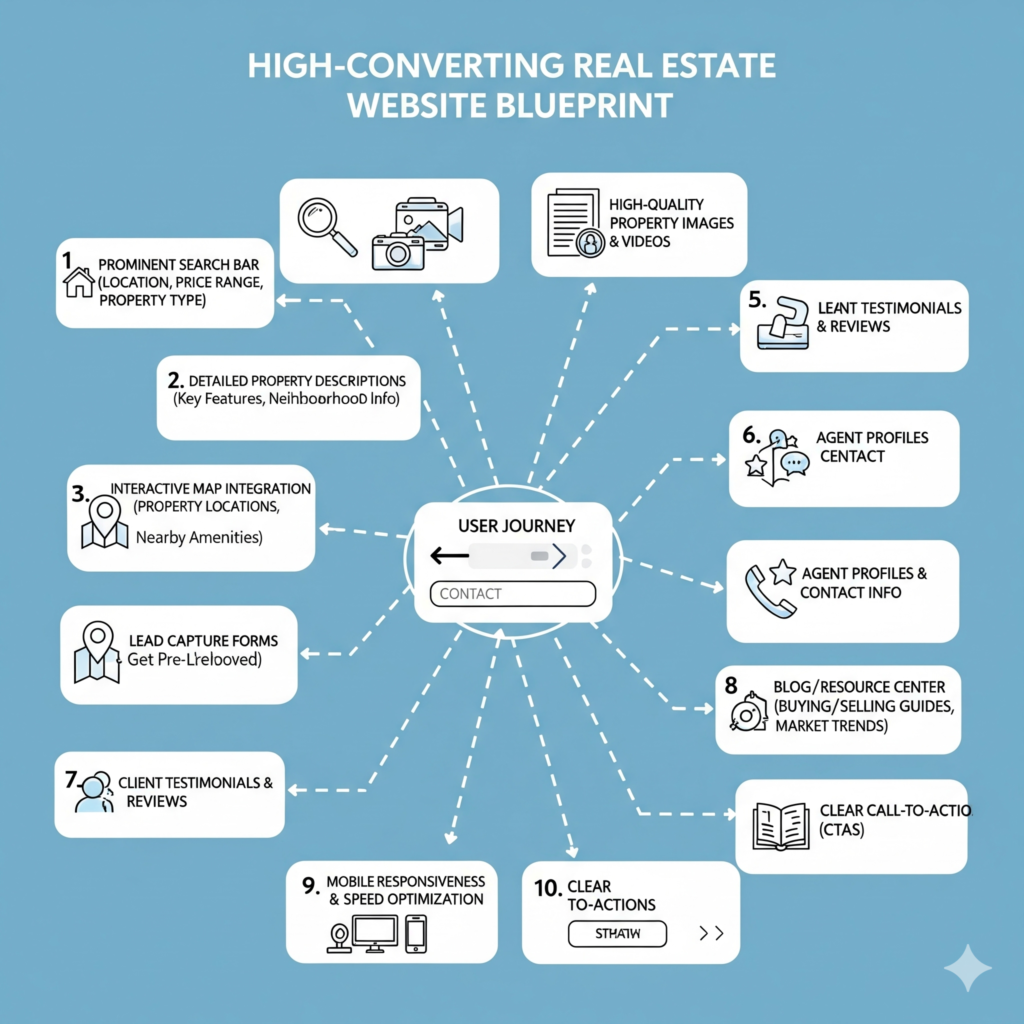
If your website isn’t actively capturing leads, engaging visitors, and positioning you as a market authority, you are leaving money on the table. real estate website design The difference between a website that simply exists and one that converts lies in its strategic features. A thoughtful real estate website design combines technology, user experience, and marketing psychology to transform a passive online brochure into an active, high-performing sales tool.
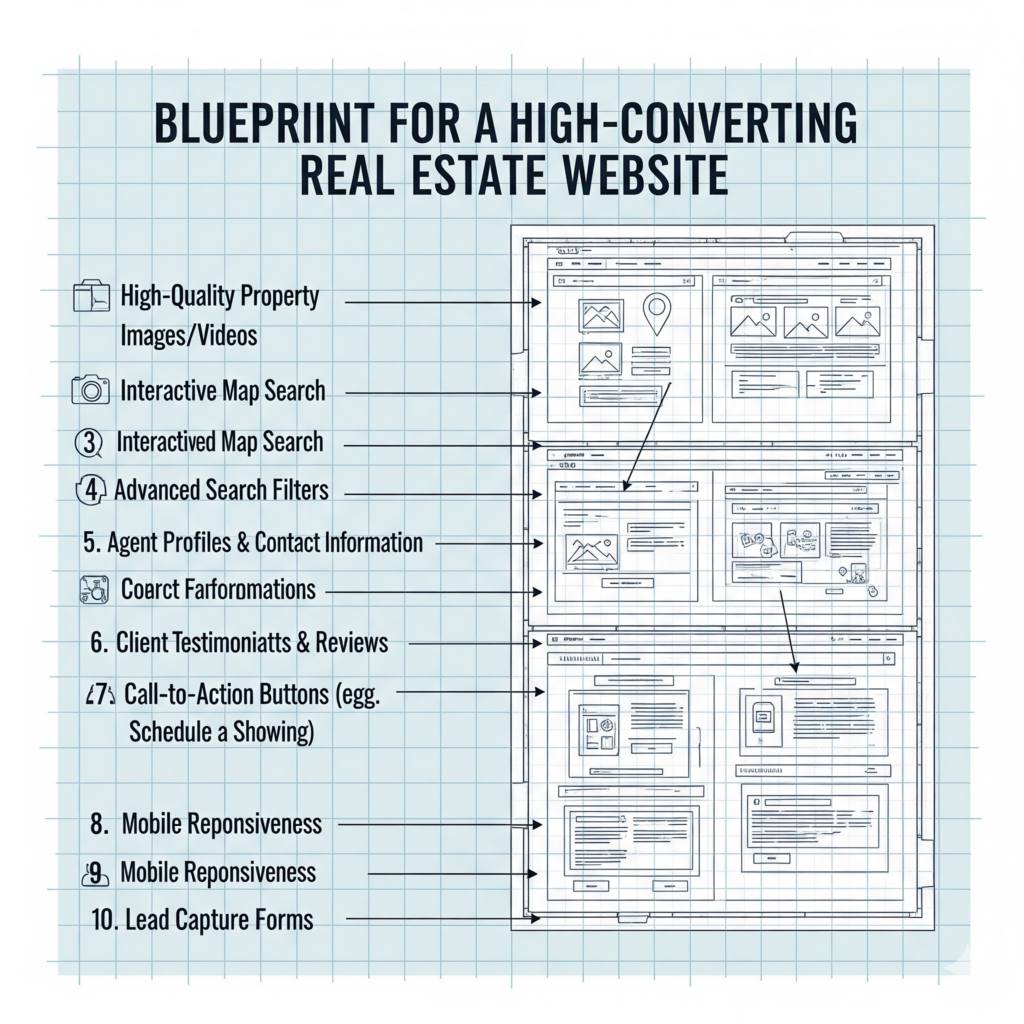
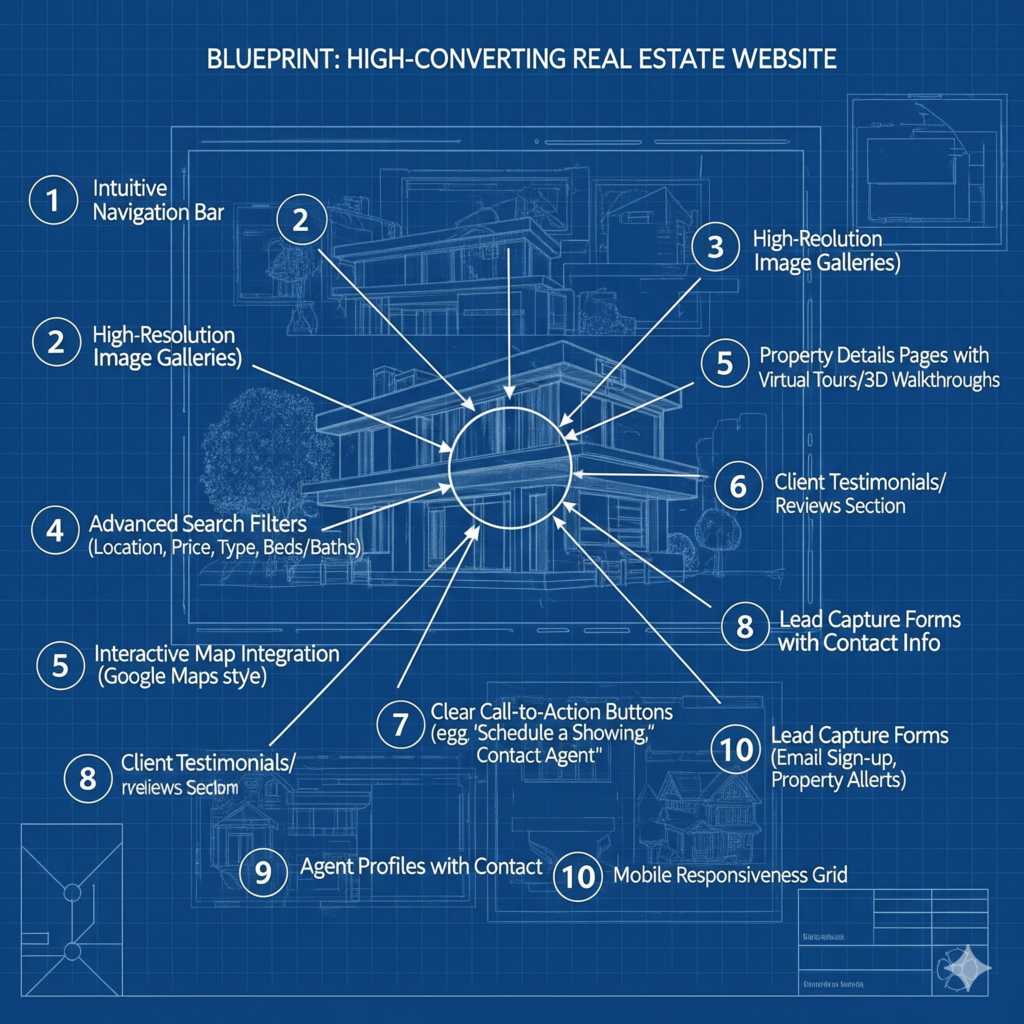
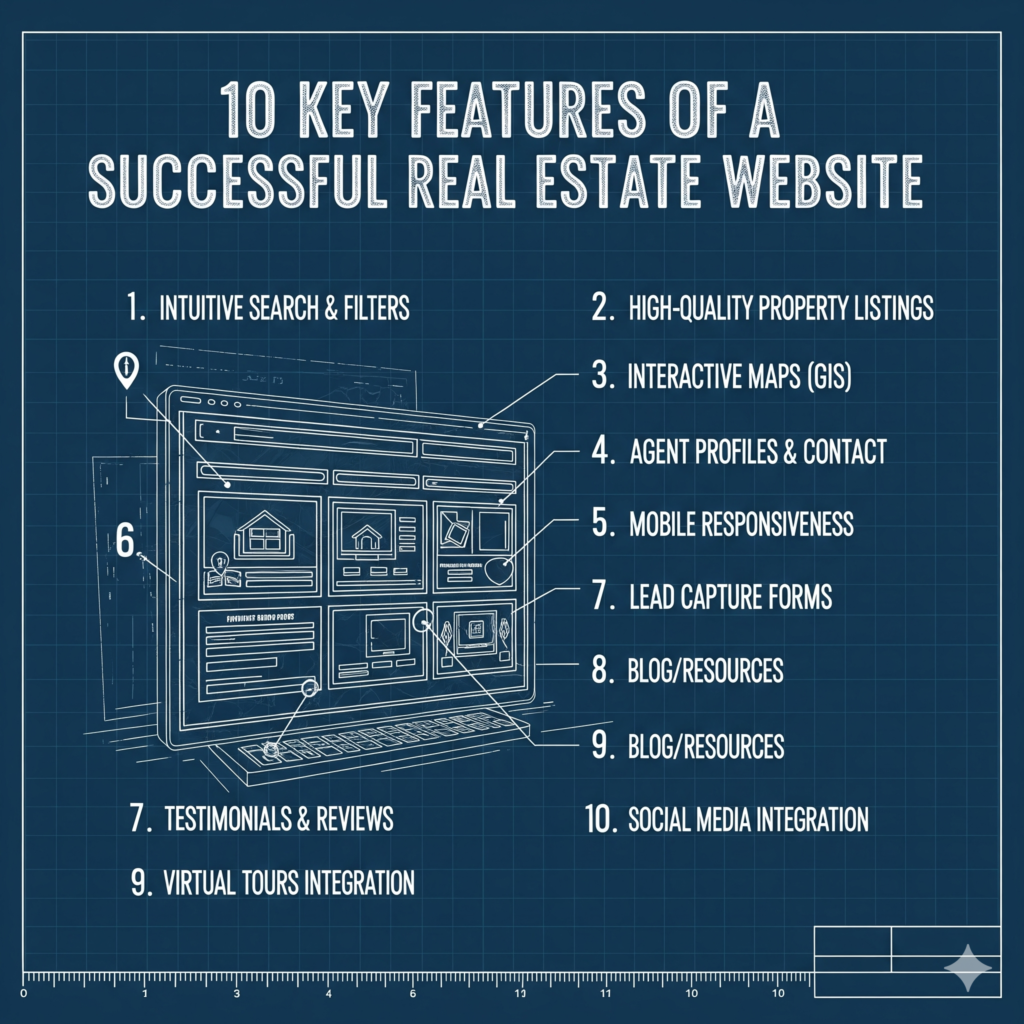
This is your ultimate blueprint. In this comprehensive guide, we will break down the ten essential, non-negotiable features that are hallmarks of an effective real estate website design. Whether you are a solo agent, a growing brokerage, or a large development firm, implementing these features will put you light-years ahead of the competition. Let’s build a website that doesn’t just look good—it delivers results.
IDX Integration in Your Real Estate Website Design
What it is: The Internet Data Exchange (IDX) is the technology that allows real estate website design professionals to display the most up-to-date property listings from their Multiple Listing Service (MLS) directly on their own websites. Instead of manually uploading, updating, or removing properties, IDX creates a live, automated feed that keeps your site’s inventory perfectly synchronized with the broader market.
Why it’s crucial for conversion: Trust and comprehensiveness. When potential buyers land on your site, they want to see everything that’s available, not just your exclusive listings. A real estate website design with a full, searchable MLS database immediately establishes credibility. It positions you as a central hub of market information, keeping visitors on your site longer and preventing them from navigating to larger portals like Zillow or Realtor.com. The longer they stay, the higher the chance they will register, save a search, or contact you directly. A core component of modern real estate website design is making this integration feel native to your brand.
How to implement it effectively:
For a WordPress website, this is typically achieved through specialized IDX plugins like IDX Broker, Showcase IDX, or iHomefinder. The key is not just to plug and play. A skilled developer will ensure the integration is seamless with your website’s design, that the search results are fast-loading, and that the lead capture forms on each listing are optimized to feed directly into your CRM.
Advanced Search in Modern Real Estate Website Design
What it is: An advanced search function goes far beyond the basic City, Price, Beds, Baths. It allows users to drill down and find properties that match their exact criteria with incredible precision. Think of filters for: square footage, year built, specific amenities e.g., swimming pool, fireplace, home office school district, just listed” status, or upcoming open houses.
Why it’s crucial for conversion: Empowerment and efficiency. The modern homebuyer has done their research and has a specific checklist. A powerful search tool respects their time and intelligence. When a user can quickly narrow down 5,000 listings to the 5 that perfectly match their needs, they feel in control and understood. This positive user experience is a direct result of thoughtful real estate website design. Furthermore, it provides you with invaluable data. When users save their detailed searches, you gain deep insights into their preferences, allowing you to provide highly personalized follow-up.
How to implement it effectively: The search bar should be prominently displayed, often front-and-center on your homepage. The interface must be intuitive, with a clean layout and easy-to-use dropdowns, sliders for price ranges, and checkboxes for amenities. On mobile devices, the search experience is even more critical; it must be fast, responsive, and easy to navigate. The results should load instantly without a full page refresh, a feature known as AJAX-powered search.
High-Resolution Visuals: Professional Photography & Video
What it is: This is the emotional core of a property listing. It encompasses professional, high-resolution photographs, cinematic video tours, and aerial drone footage. It’s about showcasing a property in its best possible light, telling a story, and allowing potential buyers to form an emotional connection before they ever set foot inside.
Why it’s crucial for conversion: Real estate website design is a visual industry. In an online setting, photos and videos are the first showing. Grainy, poorly lit smartphone pictures can instantly devalue a property and reflect poorly on your brand. Professional visuals, on the other hand, command attention, justify a price point, and generate genuine excitement. Listings with professional photography receive significantly more views and sell faster. Video tours are even more powerful, providing a sense of flow and space that static images cannot. A good real estate website design ensures these visuals are displayed beautifully without slowing down the site.
How to implement it effectively: Invest in a professional real estate website design photographer. Your real estate website design must be built to display these large image files without slowing down, which requires image optimization techniques like compression and lazy loading. Galleries should be intuitive, allowing users to easily scroll through full-screen images. Videos should be embedded from platforms like YouTube or Vimeo to ensure fast loading and cross-device compatibility.
Interactive Maps and In-Depth Neighborhood Guides
What it is: This feature provides geographical context to your listings. An interactive map plots properties visually, allowing users to explore their location in relation to landmarks. Neighborhood guides are detailed content pages that offer an insider’s look into the communities you serve, covering schools, parks, restaurants, market trends, and lifestyle.
Why it’s crucial for conversion: People don’t just buy a house; they buy a location and a lifestyle. Providing rich, detailed neighborhood information positions you as the local expert. It’s a powerful SEO strategy that captures search traffic from people exploring areas before they are ready to look at specific homes e.g., best family neighborhoods in City. When a buyer on a listing page can instantly see nearby schools, coffee shops, and parks on a map, it answers critical questions and builds their confidence. This is a value-add that elevates a standard real estate website design to an indispensable resource.
How to implement it effectively: Use Google Maps API to create dynamic, searchable maps. Each listing should have its own map view showing nearby points of interest. Create dedicated, well-written pages for each key neighborhood you service, rich with photos, videos, real estate website design and useful information. You can even embed a feed of active listings from that specific neighborhood at the bottom of the page, creating a perfect internal linking structure.
Virtual Tours and 3D Walkthroughs: The 24/7 Open House
Leveraging technology like Matterport or similar 3D scanning platforms, virtual tours create a fully immersive, dollhouse-view model of a property. Users can “walk” through the home from their computer or smartphone, looking up, down, and all around, providing an unparalleled sense of space and layout.
Why it’s crucial for conversion: This is the ultimate tool for qualifying leads and engaging long-distance buyers. A 3D walkthrough offers a level of detail that photos and videos cannot match. It gives buyers the freedom to explore at their own pace, answering questions about flow and room size. For you as an agent, it’s a game-changer. It filters out less-interested parties and ensures that the clients who book in-person showings are already highly invested. This feature is a must-have for any premium real estate website design.
How to implement it effectively: These tours can be easily embedded directly into your listing pages on your WordPress site. The key is to make them a prominent feature, not a hidden link. Use a clear call-to-action like “Explore the 3D Virtual Tour.” Ensure the embed is responsive and works flawlessly on mobile devices.
Intelligent Lead Capture Forms & CRM Integration
These are strategically placed forms designed to convert anonymous website visitors into tangible leads. This goes beyond a generic Contact Us page. It includes forms to “Schedule a Showing, Request More Info, Save This Search,or Receive New Listing Alerts.” CRM Customer Relationship Management integration automatically funnels the data from these forms into your management software.
Why it’s crucial for conversion: Speed and organization are everything in real estate website design. Without automated integration, a lead can go cold in minutes. When a form submission instantly creates a new contact in your CRM, assigns it to an agent, and triggers an automated follow-up sequence, your response time becomes immediate. This professionalism impresses potential clients and dramatically increases your chance of converting that lead. It turns your website from a passive information source into an active prospecting machine.
How to implement it effectively: Forms should be simple, asking only for essential information initially (Name, Email, Phone). Place them contextually—a Schedule a Showing form belongs on a listing page. Integration is key; a developer can connect your WordPress forms to virtually any modern CRM via an API, ensuring a reliable and seamless flow of data.
Built-in Mortgage Calculator
A simple, interactive tool on your real estate website design that allows potential buyers to estimate their monthly mortgage payments based on the property’s price, their down payment, interest rate, and loan term.
Why it’s crucial for conversion: It keeps visitors on your website and helps them make decisions. When a buyer is looking at a property, one of their first questions is, “Can I afford this?” If they have to leave your site to find a calculator on a bank’s website, you risk losing them forever. By providing this tool directly on your listing pages, you provide immediate value and answer a critical question. It’s a small feature within a larger real estate website design that adds a significant layer of professionalism and user-friendliness.
How to implement it effectively: This can be added via a WordPress plugin or custom-coded. It should be clean, simple, and easy to use. The best practice is to place it on every single listing page, as well as having a dedicated page for it in your website’s main navigation.
Detailed and Personable Agent Profiles
What it is: A dedicated page for each agent or team member that goes beyond a headshot and phone number. It should include a professional bio, areas of expertise, languages spoken, recent sales, client testimonials, and links to their social media profiles.
Why it’s crucial for conversion: Real estate website design is a relationship-based business. People work with agents they know, like, and trust. Your website is often the first place that relationship begins. A well-crafted agent profile helps build that personal connection. It showcases expertise, builds credibility, and allows potential clients to find an agent they feel they can connect with. For a brokerage, strong agent pages demonstrate the depth and strength of the entire team.
How to implement it effectively: Each agent should have their own page with a unique URL. The content should be authentic and professional. Include high-quality photos and even a short introductory video. Most importantly, display their active and sold listings directly on their profile page to provide powerful social proof.
Client Testimonials and Social Proof
What it is: Showcasing positive reviews, ratings, and success stories from past clients. This can take the form of written testimonials, video interviews, or embedded reviews from third-party platforms like Google, Zillow, or Yelp.
Why it’s crucial for conversion: Trust is the currency of real estate. Nothing builds trust faster than social proof. For a new visitor to your site, seeing that many other people have had a successful and positive experience working with you is incredibly persuasive. It mitigates risk and builds confidence in your ability to deliver. Testimonials are third-party endorsements that speak more powerfully than any marketing copy you could write yourself, and are a vital part of any trust-focused real estate website design.
How to implement it effectively: Create a dedicated “Testimonials” page, but don’t stop there. Sprinkle your best reviews throughout your website—on the homepage, on agent profiles, and on listing pages. Use a plugin to automatically pull in your 5-star reviews from Google to ensure they are always fresh and authentic.
A Content-Rich Blog Focused on Local SEO
What it is: A regularly updated blog that provides genuinely useful information to potential buyers and sellers, with a strong focus on your local market. Blog post topics could include “The Home Buying Process in 5 Tips for Selling Your Home Fast or An Analysis of the real estate website design
Why it’s crucial for conversion: This is your most powerful tool for attracting organic traffic from search engines. People who are months or even years away from a transaction are asking questions on Google. By creating content that answers those questions, you attract them to your website early in their journey. You capture their email with a helpful download (like a “Buyer’s Guide”), nurture them over time, and when they are finally ready to transact, you are the only agent they trust. It positions you as the definitive local expert and generates highly qualified, long-term leads.
How to implement it effectively: Consistency is key. Aim for at least one or two in-depth blog posts per month. Focus on quality over quantity. Use keyword research to find out what your target audience is searching for. Promote your articles on social media and through an email newsletter. Each post should end with a call-to-action, encouraging readers to contact you for personalized advice.
nice