
Choosing the right e-commerce payment solutions for your WooCommerce store is one of the most critical decisions you’ll make. You’ve spent countless hours sourcing products, designing your website, and crafting the perfect brand message. But all that hard work can be undone at the final step: the checkout. The payment gateway you choose directly impacts your customer’s trust, your conversion rates, your operational costs, and ultimately, your bottom line.e-commerce payment solutions.
In the vast world of online payments, two names consistently rise to the top: Stripe and PayPal. They are the titans of the industry, processing billions of dollars in transactions annually and trusted by millions of businesses worldwide. But while they both accomplish the same fundamental task—allowing you to accept money online—they do so with vastly different philosophies, feature sets, and user experiences.
Choosing between them isn’t as simple as flipping a coin. Is the unparalleled brand recognition of PayPal the right choice for your new store? Or does the seamless, on-site, and highly customizable experience of Stripe better align with your brand’s vision?e-commerce payment solutions
This comprehensive guide will dissect every facet of the Stripe vs. PayPal debate, specifically for WooCommerce store owners. We’ll go beyond the surface-level fee comparisons and dive deep into user experience, security, scalability, ease of use, and international capabilities. you will have the clarity and confidence to select the perfect payment gateway that not only processes transactions but actively helps your business grow.
The Critical Role of a Payment Gateway
Before we pit these two giants against each other, it’s essential to understand what a payment gateway actually is and why it’s so fundamental to your online business.e-commerce payment solutions
What is a Payment Gateway?
Think of a payment gateway as the digital equivalent of a physical credit card terminal in a retail store. It’s a sophisticated and secure bridge that connects your WooCommerce store to a payment processing network. When a customer enters their credit card details on your checkout page, the payment gateway performs a series of crucial tasks in a matter of seconds:
Encryption: It securely encrypts the sensitive card data to protect it from fraudsters. Authorization: It sends this encrypted data to the payment processor, which then communicates with the customer’s bank (the issuing bank) to verify that the customer has sufficient funds and that the card is valid. Approval/Denial: e-commerce payment solutions The bank sends back an approval or denial message. Transaction Completion: The gateway communicates this result back to your website, allowing you to either confirm the order or ask the customer to try another payment method.
This entire complex process happens almost instantly, ensuring a smooth and secure checkout experience. Choosing the right gateway is paramount because it dictates how this entire interaction unfolds. It affects everything from the look and feel of your checkout page to the fees you pay on every single sale. These e-commerce payment solutions are the engine of your online store.
Stripe – The Developer-First Powerhouse
Stripe entered the scene with a clear mission: to make accepting payments online as simple and flexible as possible for developers and modern businesses. Its philosophy is built around a seamless, on-site checkout experience and unparalleled customization.e-commerce payment solutions
An Overview of the Stripe Philosophy
Stripe’s core belief is that the payment process should be an integrated part of your website, not a separate destination. When a customer pays with Stripe, they never leave your site. They enter their card details into a form that looks and feels like it belongs to your brand. This creates a cohesive, professional, and trust-inspiring experience that is proven to reduce cart abandonment.
Key Features for WooCommerce Store Owners
Stripe Elements: This is the cornerstone of Stripe’s on-site experience. Elements are pre-built UI components that you can customize to match your site’s branding perfectly. This secure and elegant form is embedded directly on your checkout page.e-commerce payment solutions
Global Reach & Multi-Currency Support: Stripe is a global leader, supporting over 135 currencies and numerous payment methods, allowing you to sell to customers around the world seamlessly. It can handle currency conversions automatically.
Subscription & Recurring Billing: If your business model includes subscriptions, memberships, or recurring payments, Stripe’s billing engine is arguably the best in the business. It’s powerful, flexible, and built to handle complex billing logic.
Stripe Radar: This is an advanced, machine-learning-based fraud detection system. It analyzes every transaction against a massive database of global payment data to identify and block fraudulent payments before they even happen, saving you from costly chargebacks.
The Stripe API: For businesses with unique needs, Stripe’s API (Application Programming Interface) is legendary. It allows for deep integrations and the creation of completely custom payment flows, making it a favorite among developers.e-commerce payment solutions
A Deep Dive into Stripe’s Transaction Fees
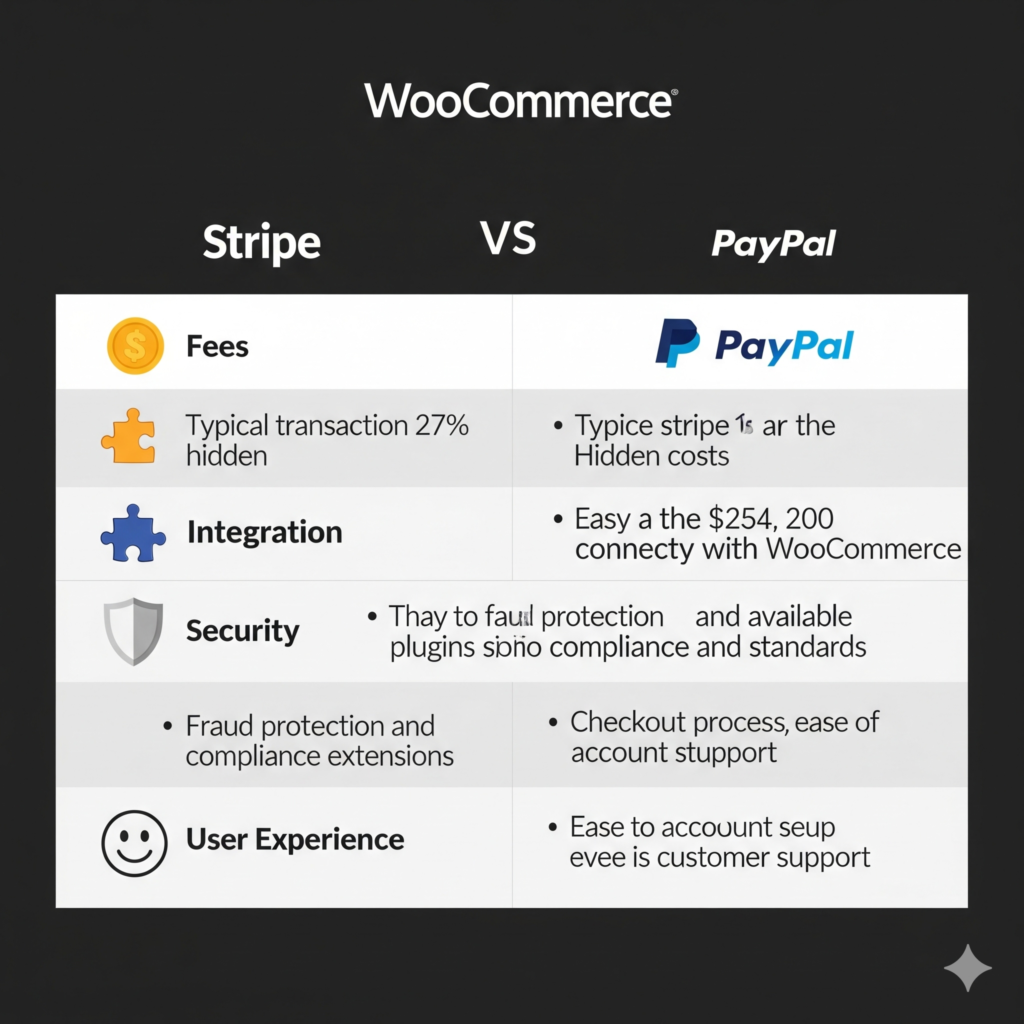
Stripe is famous for its transparent, flat-rate pricing model. For WooCommerce stores, you can typically expect:
Standard Fee: A percentage of the transaction plus a fixed fee for each successful card charge (e.g., 2.9% + $0.30 in the US). This fee varies slightly by country.
No Monthly Fees: There are no setup fees, monthly fees, or hidden costs for the standard plan. You only pay when you make a sale.
International Cards: There’s usually an additional fee for processing cards issued outside of your country (e.g., an extra 1%).
Currency Conversion: If you need to convert currency, another fee (e.g., 2%) will apply.Chargeback Fee: If a customer disputes a charge, Stripe charges a fee (e.g., $15). However, if you win the dispute, this fee is often refunded.e-commerce payment solutions
Pros of Using Stripe for WooCommerce:
Superior User Experience: The seamless, on-site checkout keeps customers on your site and increases conversion rates.
Unmatched Customization: You have complete control over the look and feel of your checkout process.
Excellent for Subscriptions: The best-in-class solution for recurring revenue models.
Advanced Fraud Protection: Stripe Radar provides enterprise-grade security.Transparent Pricing: A simple, predictable fee structure.
PayPal – The Household Name of Trust
PayPal is the original trailblazer of online payments. Its brand is synonymous with security and trust for hundreds of millions of consumers worldwide. Its philosophy is centered on leveraging this trust to make customers feel safe and complete their purchases quickly.
An Overview of the PayPal Philosophy
PayPal’s core value proposition is trust. For many online shoppers, seeing the familiar “Pay with PayPal” button is a sign of legitimacy and security. The standard PayPal experience redirects the user to PayPal’s secure site to complete the payment before sending them back to your store. While this breaks the seamless flow, it outsources the trust and security element to one of the most recognized brands on the planet.
Key Features for WooCommerce Store Owners
PayPal Checkout: This is the standard offering, allowing customers to pay with their PayPal balance, a linked bank account, or a credit/debit card stored in their PayPal wallet.
Brand Recognition: This isn’t just a feature; it’s a core asset. Many customers exclusively look for the PayPal option at checkout.
Pay Later Options: PayPal offers built-in “Buy Now, Pay Later” (BNPL) solutions like “Pay in 4,” which can significantly increase conversion rates for higher-ticket items.e-commerce payment solutions
Seller Protection: PayPal has well-established policies designed to protect merchants from fraudulent claims and chargebacks, provided you follow their guidelines.
Ease of Setup: Getting started with PayPal is incredibly fast and simple, making it a popular choice for businesses that want to start selling immediately.
A Deep Dive into PayPal’s Transaction Fees
PayPal’s fee structure can be more complex than Stripe’s, with different rates for various types of transactions. Standard Online Payments: Similar to Stripe, there’s a percentage plus a fixed fee (e.g., 3.49% + $0.49 in the US for PayPal Checkout). e-commerce payment solutions
No Monthly Fees: Like Stripe, the standard plan has no monthly fees. International Fees: Cross-border transactions typically incur higher percentage-based fees. Currency Conversion: A fee applies when converting currencies. A fee is charged for disputed transactions. PayPal Payments Pro: If you want to accept card payments directly on your site (like Stripe), you need to subscribe to a premium plan which carries a monthly fee (e.g., $30/month) in addition to transaction fees.
Pros of Using PayPal for WooCommerce:
Unrivaled Trust & Recognition: Millions of users trust and prefer PayPal, which can boost conversions. Extremely Easy to Set Up: You can create an account and start accepting payments in minutes.
Access to PayPal’s User Base: Taps into a huge network of customers who can pay with their saved details in one click.
Built-in Financing Options: “Pay Later” is a powerful conversion tool that comes standard.
Cons of Using PayPal for WooCommerce:e-commerce payment solutions
Off-Site Checkout: The standard checkout process takes customers away from your website, which can lead to cart abandonment.e-commerce payment solutions
Complex Fee Structure: Fees can be harder to predict compared to Stripe’s simple flat-rate model.
Account Holds and Freezes: PayPal is famously cautious and has a reputation for holding funds or freezing accounts, which can be a major issue for cash flow.
On-Site Payments Cost Extra: Achieving a Stripe-like on-site experience requires a paid monthly plan.
Head-to-Head Comparison for WooCommerce
Let’s put Stripe and PayPal side-by-side to compare the factors that matter most to a WooCommerce store owner.e-commerce payment solutions
Feature Stripe PayPal
Checkout Experience On-Site & Seamless. Fully customizable to match your brand. Customer never leaves your store. Off-Site by Default. Redirects to PayPal’s site. On-site checkout requires a paid plan.
User Trust High for tech-savvy users. The trust is in your professional-looking site. Extremely High. The brand itself is a massive trust signal for all types of users.
Transaction Fees Simple, transparent flat-rate (e.g., 2.9% + 30¢). More complex, variable rates. Can sometimes be slightly higher.
Ease of Setup Straightforward for basic setup, more technical for advanced features. Extremely easy and fast for beginners to get started.e-commerce payment solutions
Subscriptions Best-in-class, powerful, and flexible recurring billing engine. Supported, but the tools are less robust and flexible than Stripe’s.
International Sales Excellent multi-currency support and local payment methods. Strong global presence, but international fees can be higher.

Fraud Protection Advanced machine-learning via Stripe Radar. Strong Seller Protection policies.
Customer Support Primarily email and chat-based; phone support can be hard to reach. More accessible phone support, but experiences can be mixed. Export to Sheets
Beyond the Big Two: Other E-commerce Payment Solutions
While Stripe and PayPal are the dominant players, they aren’t the only options. Depending on your needs, it might be worth considering alternatives:
Square: Excellent for businesses with both an online (WooCommerce) and physical (in-person) presence, as it seamlessly integrates both. Authorize.net: One of the oldest and most trusted payment gateways, popular with larger enterprises that need a dedicated merchant account.
Local Gateways: Depending on your primary market, using a local payment gateway (e.g., bKash, Nagad in Bangladesh) can be crucial, as many customers may prefer it. Often, these can be used in conjunction with Stripe or PayPal. Conclusion – Which is Right for YOUR Store?e-commerce payment solutions.
After this deep dive, it’s clear there is no single “winner.” The best choice depends entirely on your business priorities, technical comfort level, and target audience.You should choose Stripe if:
Brand Experience is Paramount: You want a completely seamless, on-site checkout that feels like a natural extension of your brand.
You Value Customization: You want granular control over the look, e-commerce payment solutions feel, and functionality of your payment flow.
You Have a Subscription Model: Your business relies on recurring revenue, and you need a powerful engine to manage it.
Your Audience is Tech-Savvy: Your customers are comfortable entering their credit card details on a well-designed, secure website.e-commerce payment solutions
You should choose PayPal if:
You Are Just Starting Out: You need the quickest and easiest way to start accepting payments immediately.
Trust is a Major Hurdle: Your brand is new, and you want to “borrow” the immense trust and brand recognition of PayPal to increase conversions.e-commerce payment solutions
Your Audience Prefers PayPal: You know a significant portion of your customer base actively uses and prefers paying with their PayPal account.
You Want to Offer Financing: You want to leverage “Buy Now, Pay Later” options without a complex integration.
The Hybrid Strategy: Why Not Both?
Ultimately, the smartest strategy for many WooCommerce stores is not to choose one over the other, but to offer both. By providing Stripe for direct credit card payments (labeled simply as “Pay with Credit Card”) and also showing the “Pay with PayPal” button, you cater to all customer preferences. This hybrid approach often yields the highest conversion rates, giving you the best of both worlds: the seamless experience of Stripe and the trusted familiarity of PayPal.
Your choice of e-commerce payment solutions is a foundational decision. e-commerce payment solutionsTake the time to consider these factors carefully, align the choice with your brand’s goals, and build a checkout experience that is secure, seamless, and optimized for success.
The Reality of Using PayPal in Bangladesh
Any methods you might hear about for using PayPal—such as using a friend or relative’s account overseas, or using unverified third-party services—carry significant risks. These methods often violate PayPal’s terms of service and can lead to your funds being permanently frozen without any recourse.
For Bangladeshi businesses, the clear and professional choice for credit card processing remains Stripe (via the method described above). While the lack of PayPal is a challenge, focusing on a robust Stripe integration is the most secure and scalable path forward.
Can I use both Stripe and PayPal on my WooCommerce store?
Absolutely, and in most cases, you should. Offering both gateways is a proven strategy for maximizing conversions. e-commerce payment solutions Some customers exclusively trust PayPal’s brand, while others prefer the convenience of entering their card details directly on your site via Stripe without being redirected. By providing both options, you cater to everyone’s preference and reduce the chances of a customer abandoning their cart simply because their favorite payment method wasn’t available.
Which platform is better for handling customer disputes and chargebacks?
Stripe’s Radar is a proactive, machine-learning tool that aims to block fraudulent transactions before they happen. Their dispute process is data-driven, and they provide a clear dashboard for you to submit evidence.e-commerce payment solutions
PayPal’s Seller Protection is a well-known policy that protects merchants from fraudulent claims of “unauthorized transaction” or “item not received,” provided you have proof of shipment and follow their guidelines. The process can sometimes feel more automated and less direct than Stripe’s.
Do I absolutely need an SSL Certificate to use Stripe or PayPal?
Yes, 100%. An SSL (Secure Sockets Layer) certificate encrypts the data transferred between a customer’s browser and your website. It’s what enables the “https://” and the padlock icon in the address bar. Modern web browsers will flag your site as “Not Secure” without one, and payment gateways like Stripe require it to process payments. Beyond being a technical requirement, e-commerce payment solutions it is a fundamental sign of trust for your customers. Without an SSL certificate, most visitors will refuse to enter any personal or payment information on your site.